
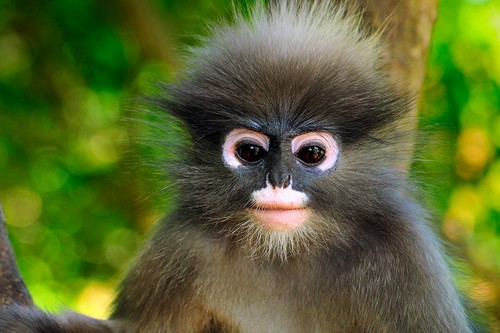
MONKEYS
Monkey is a common name that may refer to most mammals of the infraorder Simiiformes, also known as the simians. Traditionally, all animals in the group now known as simians are counted as monkeys except the apes, a grouping known as paraphyletic; however in the broader sense based on cladistics, apes (Hominoidea) are also included, making the terms monkeys and simians synonyms in regard of their scope. Monkeys are divided into the families of New World monkeys (Platyrrhini) and Old World monkeys (Cercopithecidae in the strict sense; Catarrhini in the broad sense, which again includes apes).
Many monkey species are tree-dwelling (arboreal), although there are species that live primarily on the ground, such as baboons. Most species are mainly active during the day (diurnal). Monkeys are generally considered to be intelligent, especially the Old World monkeys.
New World monkeys and catarrhine monkeys emerged within the simians some 35 million years ago. Old World monkeys and apes emerged within the catarrhine monkeys some 25 million years ago.
WHERE WILL YOU FIND THEM?
Scientific classifications are now more often based on monophyletic groups, that is groups consisting of all the descendants of a common ancestor. The New World monkeys and the Old World monkeys are each monophyletic groups, but their combination was not, since it excluded hominoids (apes and humans). Thus the term "monkey" no longer referred to a recognized scientific taxon. The smallest accepted taxon which contains all the monkeys is the infraorder Simiiformes, or simians.